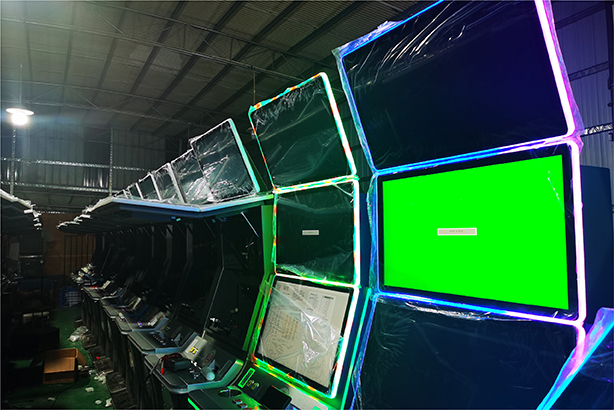

The American casino industry is a multi-billion-dollar market, where slot machines stand as the backbone of revenue generation—accounting for over 70% of gaming floor profits in many major casinos. As technology evolves, touch interfaces have become a critical component of modern slot machines, shaping player experience and operational efficiency. Among the various touch technologies available, Projected Capacitive (PCAP) touch monitors have emerged as the clear preference for American slot machine manufacturers, surpassing Infrared (IR) touch monitors in adoption and reliability. But what drives this preference? This article delves into the core reasons, exploring how PCAP technology aligns with the unique demands of the U.S. slot machine market, from regulatory compliance and player expectations to harsh casino environments.
To understand the preference, it’s essential to grasp the fundamental differences between the two technologies. PCAP touch monitors operate by creating a uniform electrostatic field across a glass surface embedded with transparent electrodes. When a conductive object (like a finger) touches the screen, it disturbs the field, and a controller accurately calculates the touch position. IR touch monitors, by contrast, use an array of infrared LEDs and sensors around the screen’s bezel to form an invisible light grid; a touch is detected when an object interrupts these light beams.
While both enable touch interaction, their design and performance characteristics lead to stark differences in suitability for slot machine applications. For American manufacturers, these differences directly impact compliance, player satisfaction, and long-term operational costs—making PCAP the superior choice.
American slot machine players, accustomed to the intuitive multi-touch interactions of smartphones and tablets, now expect the same level of responsiveness and functionality from gaming devices. PCAP touch monitors excel here, supporting true 10-point multi-touch and advanced gestures (pinch-to-zoom, swipe, rotate) with exceptional accuracy. This capability is critical for modern slot machine features, such as interactive bonus rounds, dynamic game menus, and social gaming elements that require fluid, multi-finger interactions.
IR touch monitors, however, struggle with multi-touch performance. While some high-end IR models claim multi-touch support, their accuracy degrades significantly with multiple simultaneous touches—often misinterpreting gestures or registering false touch points. This limitation restricts game designers’ ability to create engaging, immersive experiences, a key competitive differentiator in the U.S. market. For manufacturers aiming to attract and retain players, PCAP’s superior multi-touch functionality is non-negotiable.
Casino floors are harsh environments for touch technology, with bright lighting, dust, spills, and constant foot traffic. These conditions pose significant challenges for IR touch monitors, which are highly susceptible to environmental interference—a flaw that directly impacts gameplay reliability.
IR touch screens rely on light beams to detect touches, making them vulnerable to interference from external light sources. Sunlight streaming through casino windows, overhead spotlights, or even nearby incandescent bulbs can disrupt the infrared grid, causing false touches or unresponsive screens. In contrast, PCAP touch monitors use electrostatic field detection, which is immune to light interference. Their sealed glass design also provides superior protection against dust, spills, and cleaning chemicals—with most industrial-grade PCAP models boasting an IP65 rating, ensuring durability in messy casino environments.
Additionally, IR touch bezels (housing LEDs and sensors) are prone to damage from accidental impacts or vandalism—common risks on busy gaming floors. PCAP monitors, with their seamless glass surfaces and integrated sensor design, eliminate this vulnerability, offering greater structural durability and a longer lifespan (up to 50 million touches, compared to IR’s typical 30 million touches).
The American gaming industry is one of the most heavily regulated in the world, with each state imposing rigorous standards for slot machine design, performance, and transparency. PCAP touch monitors are uniquely positioned to meet these regulatory requirements, while IR touch monitors often fall short.
For example, regulations in states like Iowa and Florida mandate that slot machine touch interfaces must provide consistent, accurate touch recognition—with no hidden or unresponsive touch points—and allow for easy recalibration by casino staff. PCAP’s high touch accuracy (linearity error < 1.5%) and stable performance (no drift over time) ensure compliance with these standards. IR touch monitors, however, suffer from calibration issues in changing environments (e.g., temperature fluctuations) and are prone to drift, requiring frequent recalibration to maintain accuracy—a burden for casino operators and a potential compliance risk.
Furthermore, U.S. regulations require slot machines to display game information (payout percentages, bonus rules) clearly and legibly. PCAP monitors, with their high light transmittance (up to 90%) and minimal reflection, preserve the display’s clarity and brightness, ensuring players can easily read critical information. IR touch monitors, while offering high light transmittance in ideal conditions, often suffer from glare and reflection issues in bright casino settings, compromising visibility and regulatory compliance.
In the competitive U.S. casino market, player experience is paramount. PCAP touch monitors deliver a fast, responsive, and intuitive interaction that aligns with player expectations. With a response time of ≤5ms, PCAP screens register touches instantly—eliminating the lag that frustrates players and disrupts gameplay. This speed is critical for fast-paced slot machine action, where every second counts in maintaining engagement.
IR touch monitors, by comparison, have slower response times (typically 10-15ms) due to the need to scan the entire light grid before registering a touch. This lag is noticeable to players, creating a clunky, unrefined experience that can drive them to switch to other machines. Additionally, PCAP’s pressure-free touch detection (a light finger tap suffices) is more intuitive than IR’s reliance on interrupting light beams, which can require more deliberate contact—further enhancing the player experience.
American slot machine manufacturers and casino operators prioritize total cost of ownership (TCO), and PCAP touch monitors offer significant long-term cost advantages over IR models. As noted earlier, PCAP’s durable glass surface and sealed design resist scratches, impacts, and environmental damage, reducing the need for frequent repairs. Their longer lifespan (50 million touches vs. IR’s 30 million) also means fewer replacements over the machine’s operational life.
IR touch monitors, by contrast, require more maintenance. Their exposed LEDs and sensors are prone to wear and damage, and environmental interference often necessitates frequent calibration or component replacement. Over time, these maintenance costs add up, making IR a more expensive choice despite its lower initial price point. For manufacturers aiming to deliver reliable, cost-effective slot machines to casino clients, PCAP’s lower TCO is a key selling point.
American slot machine manufacturers offer a wide range of machine designs—from compact upright models to large-format, curved-screen units. PCAP touch monitors provide greater flexibility for customization and integration, adapting to these diverse designs. Their open-frame design and thin profile allow for seamless embedding into slot machine cabinets, while support for various screen sizes (from 10.1 to 55 inches) and aspect ratios ensures compatibility with different machine layouts.
IR touch monitors, with their bulky bezels (needed to house LEDs and sensors), are less flexible for integration—especially in sleek, modern slot machine designs. They also struggle with curved screens, as the infrared light grid requires a flat surface to function accurately. For manufacturers pushing the boundaries of slot machine design to stand out in the market, PCAP’s flexibility is a critical advantage.
American slot machine manufacturers’ preference for PCAP touch monitors over IR models is not arbitrary—it’s a strategic choice driven by the unique demands of the U.S. gaming industry. PCAP technology delivers the multi-touch performance, environmental resistance, regulatory compliance, and player experience that modern slot machines require, while offering long-term cost efficiency and design flexibility.
As the U.S. casino industry continues to evolve—with a growing focus on immersive gaming experiences and strict regulatory oversight—PCAP touch monitors will remain the gold standard for slot machine manufacturers. For those looking to develop competitive, reliable slot machines for the American market, choosing PCAP is not just a technological decision; it’s a commitment to meeting the needs of players, operators, and regulators alike.
If you’re a slot machine manufacturer navigating the U.S. market, selecting the right touch technology is critical to success. PCAP touch monitors from trusted providers ensure your machines stand out with superior performance, compliance, and player satisfaction—driving revenue and long-term growth.